

Book a demo
Login


An Engineering Document Management System (EDMS) is software designed to store, organize, control, review, distribute, and track engineering documents throughout their lifecycle. It provides a controlled source for technical documentation such as P&IDs, drawings, datasheets, specifications, calculations, vendor documents, certificates, manuals, and as-built records.
Unlike a general document management system, an EDMS is designed around the way engineering information changes. Documents move through revisions, reviews, approvals, issues, transmittals, construction, commissioning, and eventually handover to operations.
For owner-operators, EPCs, engineering contractors, and suppliers, the objective is therefore not simply to store documents. It is to ensure that the correct document, at the correct revision and status, can be found and trusted by the people and systems that need it.
An engineering document management system provides controlled processes for creating, reviewing, approving, issuing, retrieving, and retaining engineering documentation.
A typical EDMS supports:
Together, these capabilities create traceability from document creation through engineering, procurement, construction, commissioning, handover, and operations.
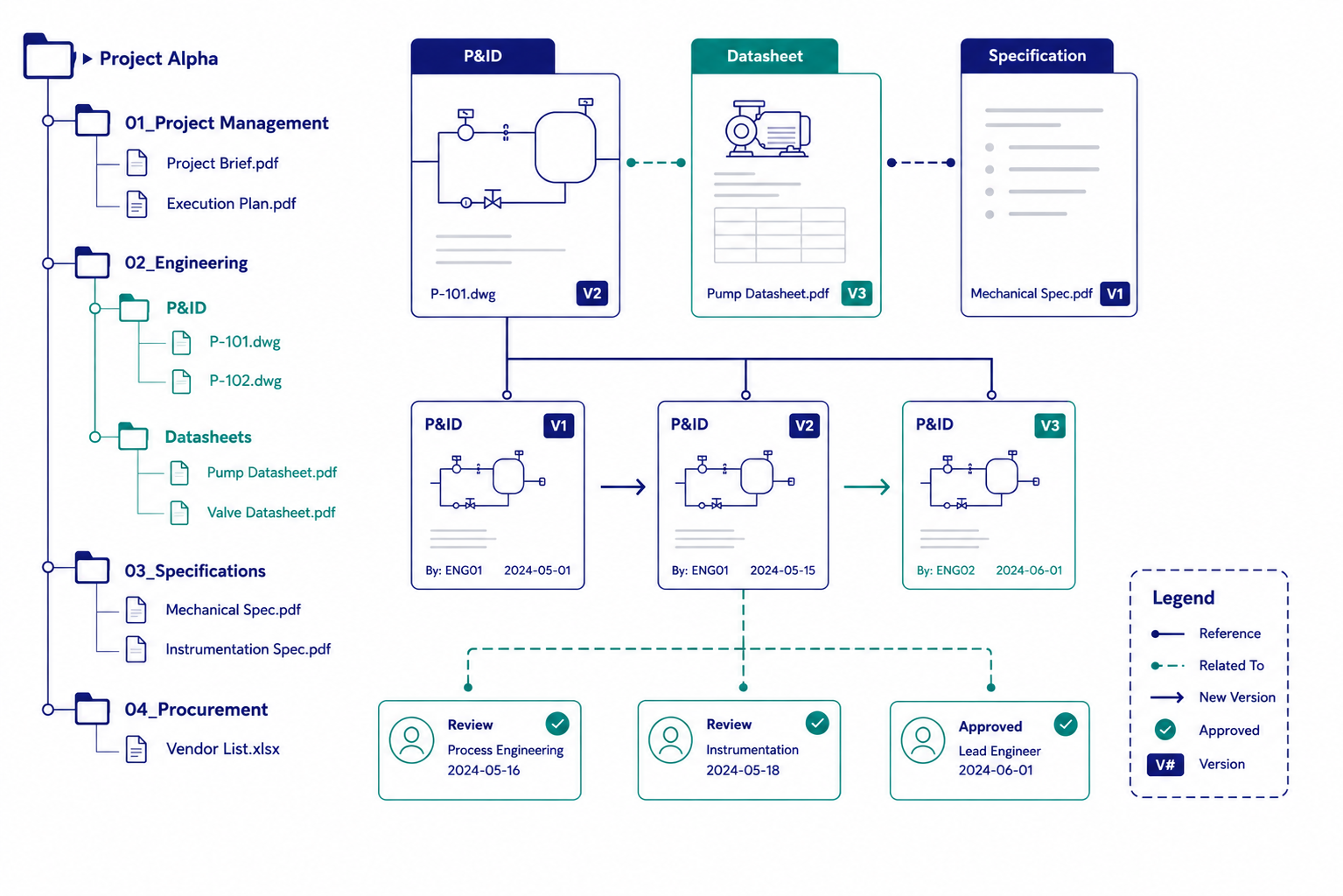
Engineering documents rarely remain static.
A drawing, for example, may begin as an engineering deliverable, pass through several internal reviews, be issued to a supplier, return with comments, be revised for construction, and finally become an approved as-built record.
An EDMS controls this lifecycle.
A typical workflow may look like:
Create or receive → classify → review → comment → revise → approve → issue → distribute → update → as-built → handover
At each stage, the system maintains the document's metadata, revision, status, ownership, approval history, and distribution record.
This is particularly important on capital projects where thousands of documents may move simultaneously between engineering disciplines, suppliers, contractors, and the owner-operator.
A Document Management System (DMS) is designed to manage general business documents such as contracts, policies, reports, correspondence, and office files.
An Engineering Document Management System (EDMS) adds controls required for technical and engineering information.
These commonly include engineering document numbering, revision management, approval workflows, transmittals, engineering metadata, document status codes, supplier submissions, and relationships between documents and physical assets.
The distinction matters because an engineering drawing is not simply a file. Its revision, approval status, equipment relationship, and issue history determine whether it is safe and appropriate to use.
SharePoint, Teams, Google Drive, and similar platforms can store and share documents, but document storage alone is not engineering document control.
Engineering projects typically require additional governance around:
Generic platforms can sometimes be configured to support parts of these processes, but a purpose-built EDMS incorporates them into the information model and workflow.
The relevant question is therefore not simply “Where are our documents stored?”
It is “Can we determine which document is current, what it applies to, who approved it, where it has been issued, and whether it is ready for operations?”
An EDMS and a Common Data Environment (CDE) overlap, but they are not identical.
An EDMS focuses primarily on the governance and lifecycle of engineering documentation. A CDE is a broader environment for managing and exchanging project information across multiple disciplines and information types.
On complex capital projects, the two concepts increasingly converge. Modern information platforms may manage engineering documents, structured data, supplier information, workflows, and asset relationships within the same governed environment.
Engineering projects can generate tens or hundreds of thousands of documents across multiple organizations.
Without controlled engineering document management, teams can encounter:
These are not simply document-control problems. They can affect engineering quality, construction efficiency, commissioning, maintenance readiness, regulatory traceability, and the long-term integrity of asset information.
A well-implemented EDMS establishes a governed information baseline throughout the project rather than attempting to reconstruct one at the end.
Supplier documentation is one of the most demanding areas of engineering document management.
A single equipment package can generate drawings, datasheets, calculations, certificates, manuals, inspection records, spare-parts information, and other deliverables that must be reviewed and ultimately linked to the supplied equipment.
An EDMS helps control these submissions against document requirements and project workflows.
However, collecting the files is only part of the challenge. The information must also be complete, correctly classified, and associated with the appropriate equipment and tags.
This is why engineering document management increasingly overlaps with supplier data management.
One of the most valuable relationships in an industrial EDMS is the connection between a document and the physical asset it describes.
A P&ID may reference many tags. A datasheet may describe one specific item of equipment. A vendor manual may apply to an entire package and its components.
Connecting these relationships allows users to navigate in both directions:
Document → equipment
and
Equipment → relevant documentation
The Master Tag Register (MTR) and asset hierarchy therefore provide important structures for organizing engineering information beyond document folders.
This becomes particularly valuable in operations, where maintenance and engineering teams often begin their search with an equipment tag rather than a document number.
Project handover is one of the strongest tests of an EDMS.
During execution, the system may contain multiple revisions, review copies, supplier submissions, comments, and work-in-progress documents. Operations, however, needs a controlled and usable final information baseline.
Before handover, documentation therefore needs to be checked for:
The resulting document handover package should be more than a collection of files. It should preserve enough structure and context for the information to remain usable after the project organization has demobilized.
Traditional document management treats the document as the primary object.
Industrial asset information management requires another dimension: the relationship between documents and structured asset data.
A pump may have a tag number, equipment class, manufacturer, model, technical attributes, spare parts, datasheets, certificates, drawings, and maintenance documentation. If those records exist independently, users still have to reconstruct the relationship between them.
Connecting engineering documents to structured asset records turns the EDMS from a document repository into part of the wider asset information environment.
This relationship is particularly important when information must ultimately flow into CMMS, EAM, ERP, maintenance, inspection, or other operational systems.
When evaluating engineering document management software, organizations should consider more than document storage capacity.
Important criteria include:
The best EDMS is ultimately the one that preserves the integrity and usability of engineering information across organizational and lifecycle boundaries.
Sharecat connects engineering documents, structured asset data, and supplier information within one governed environment.
Rather than treating drawings, datasheets, manuals, certificates, and vendor documents as isolated files, Sharecat can associate documentation with the equipment tags and asset information it describes.
During project execution, this supports controlled document processes alongside supplier information management and structured data validation.
The result is continuity between three information layers that are frequently managed separately:
Documents → Tags → Asset data
At handover, approved documentation can remain associated with the corresponding equipment and structured information, creating a more usable information baseline for operations and downstream CMMS, EAM, and ERP environments.
This is particularly relevant for owner-operators and EPCs that need to manage engineering information across project delivery, supplier collaboration, handover, and the operational asset lifecycle.
What does EDMS stand for?
EDMS stands for Engineering Document Management System when used in an engineering context. The acronym can also mean Electronic Document Management System in broader document-management contexts.
What is an engineering document management system?
An engineering document management system is software used to control engineering documents, revisions, metadata, workflows, approvals, transmittals, and distribution throughout the document lifecycle.
What is the difference between an EDMS and a DMS?
A DMS manages general organizational documents. An EDMS adds engineering-specific controls such as technical metadata, revision management, approval workflows, document registers, transmittals, and relationships with equipment.
Is SharePoint an EDMS?
SharePoint provides document storage, collaboration, permissions, and workflow capabilities, but it is not inherently an engineering-specific EDMS. Organizations can configure it for some engineering document-control processes, although specialized requirements may require significant configuration or additional systems.
What industries use EDMS software?
EDMS platforms are widely used in asset-intensive industries including oil and gas, chemicals, power and utilities, renewables, mining, pharmaceuticals, manufacturing, infrastructure, and other industries managing complex engineering assets.
How does an EDMS support project handover?
An EDMS maintains document revisions, status, metadata, approvals, and relationships throughout project execution. This makes it possible to identify and transfer the final approved information baseline to operations as part of a structured digital handover.
What is the relationship between an EDMS and asset management?
An EDMS controls engineering documentation, while asset management systems manage physical assets and operational activities. Connecting documents to equipment tags and asset records allows engineering information to remain accessible in the context of the physical asset throughout its lifecycle.


ISO
27001
Certified


